
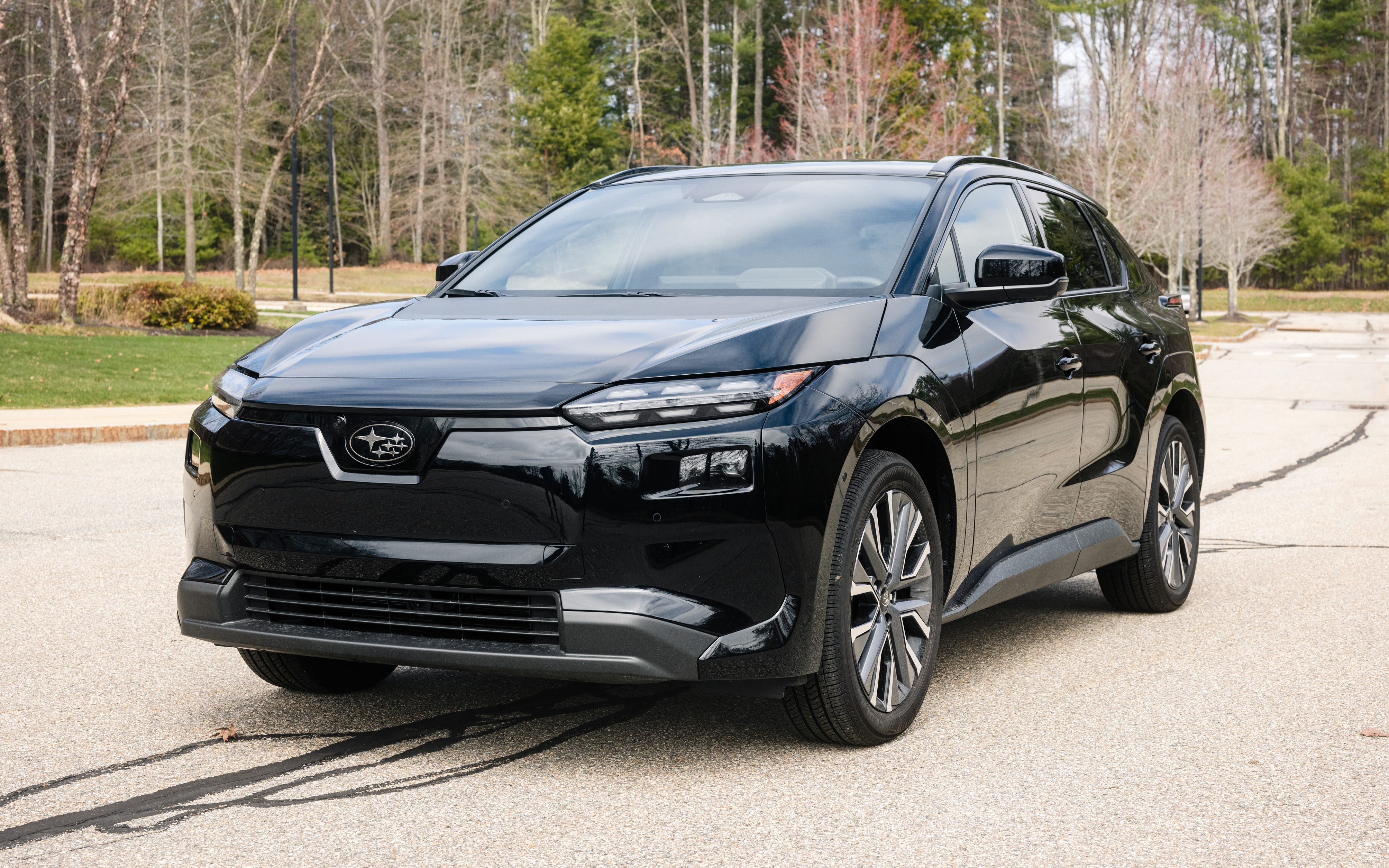
I’m a big fan of internal combustion engines, manual transmissions, and maximum driver-car engagement. Which has led to a certain skepticism of electric vehicles and the seeming total lack of behind-the-wheel joy. Then I spent a week with the 2026 Subaru Solterra. It’s the first time I’ve had a chance to dive deep on an EV, and it’s changed my tune.
EVs Are For Families


We’re a family of 5 with 3 kids in the middle-high school range. Days are consumed with driving in circles - school, home, school, swim practice, supermarket, school, and so on. This is a terrible environment for an ICE car like my old Mazda6 or our even older Ford Transit Connect.
You can almost hear the powertrain groaning in angst at being driven 2 miles at 22 mph and shut down, only to repeat the process an hour later. And I can absolutely hear myself groaning in irritation at chasing the cheapest gas station prices around town. Last I checked, fuel wasn’t getting any cheaper.
For us, the ideal dual-vehicle combo is something like our Ford minivan and something like this Solterra EV. The minivan covers long-distance bases without range anxiety - think drives from New Hampshire to visit family in New Jersey or winter excursions to far-flung skiing destinations.
Driving Range Isn’t Everything
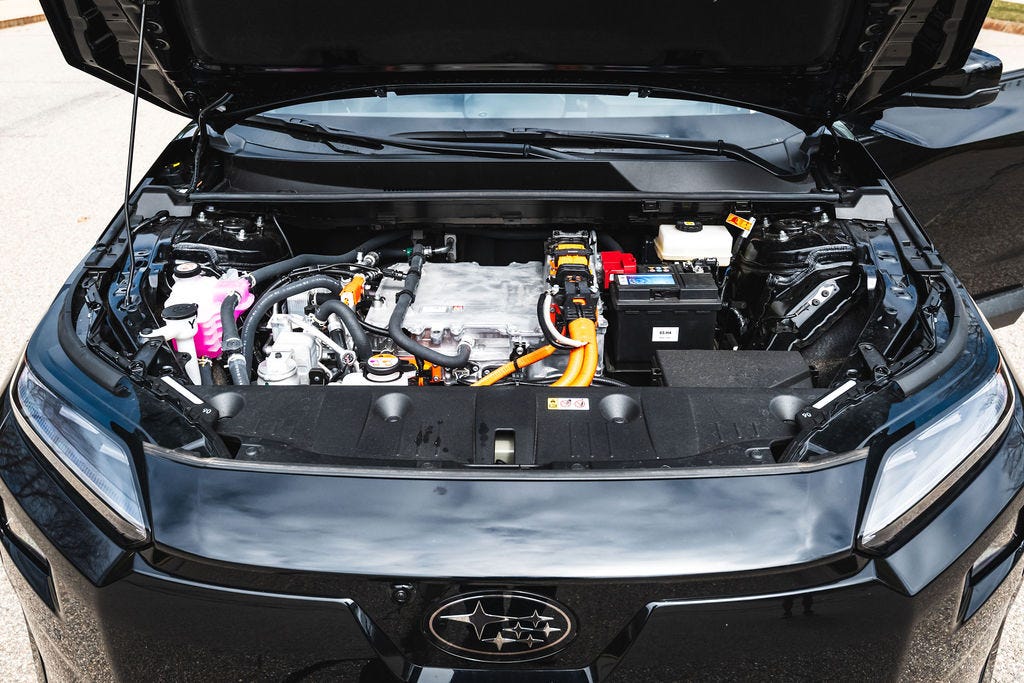
And for everything else, there is the Solterra. Driving range of EVs seems to be the new metric by which all EVs are measured. Lucid’s Air sedan in Grand Touring trim is a front-runner for EV with the biggest driving range, somewhere north of 500 miles. If you’re willing to drop $100,000. Neat. Don’t get me wrong, the Air looks killer and 500+ miles of range is impressive. But come on, this is a toy for the heavy hitters, not an EV for the masses.
The entry-level 2026 Subaru Solterra Premium squeaks just under $40,000 to start with destination. It offers 288 miles of range, which is more than enough for those aforementioned family duties. Axios says that Americans travel an average of 42 miles per day. This is certainly broad strokes, but there’s a case to be made here for broader EV adoption. And going hundreds of miles between charge-ups makes a case for options like the Solterra.
The New And Improved Solterra


I spent time with the Solterra Limited, which bumps the price closer to $43,000, still relatively low-priced these days. No matter the trim line, this twin to the Toyota bZ has undergone a ton of improvements since the Solterra debuted for the 2023 model year.
Battery capacity has increased a smidge, from 72.8 to 74.7 kWh, but max range has jumped from 227 to 288 miles, thanks to a whole lot of engineering that is not immediately obvious. New wheel bearings reduce drag by 18%, the front control arms are lighter, motor cases are smaller, the chassis is stiffer, and the battery preconditioning system has been upgraded.
It’s a lot of little iterations that add up to nearly 27% more driving range. Frankly, 227 miles would be enough for 42 miles of average daily driving distance, but surely longer ranges will help Subaru sell more Solterras. Get would-be buyers in the driver’s seat, and that shouldn’t be too hard.
Save Some Money With The Base Motor
Premium and Limited models get the 233-horsepower setup, while XT’s see a bump to 338 hp. In either case, AWD is standard, and so is video game-like acceleration. I haven’t driven an XT, but the Solterra Limited jumps off the line with all the instantly gratifying torque response that EVs are known for. Do I always want the car that is faster? Yes I do. But for between 40 and 43 grand, I would happily run around with the less powerful Solterra.
Its regenerative braking system, controlled via what look like shifter paddles, feels like downshifting on a manual transmission. You can’t drive with one pedal, but you can slow roll at 2 mph with max regen activated. Toyobaru’s brake hold button is a modern automotive marvel. Click it on - you must do so after every restart - and at a full stop, the Soltera will remain unmoving with your foot off the brake until you tag the go pedal. It’s a nice way to give your tootsies a chance to relax.
I did find the 20” wheels to be a bit crashy over pockmarked roads, further making a case for the base model with its 18” rims that are likely easier riding over rough roads and definitely easier on the wallet when it comes time for new tires.
Lexus Vibes


Painted in black, the updated Solterra is an elegant rig. At least one onlooker thought it was a Lexus. Subaru refreshed the front end, making it less busy than before, and the black wheel arch trim vanishes when the rest of the car is finished in Astro Black Mica like the one I drove.
Inside, however, I’d suggest a two-tone upholstery and/or the panoramic glass roof to avoid the overly dark cabin of black StarTex with a color-matched headliner. That faux leather is remarkably soft, but you’ll find a fair amount of hard plastic surfaces. A Lucid Air Grand Touring is likely all soft-touch, but for $43,000, I’m not really complaining.
A Cabin That Works
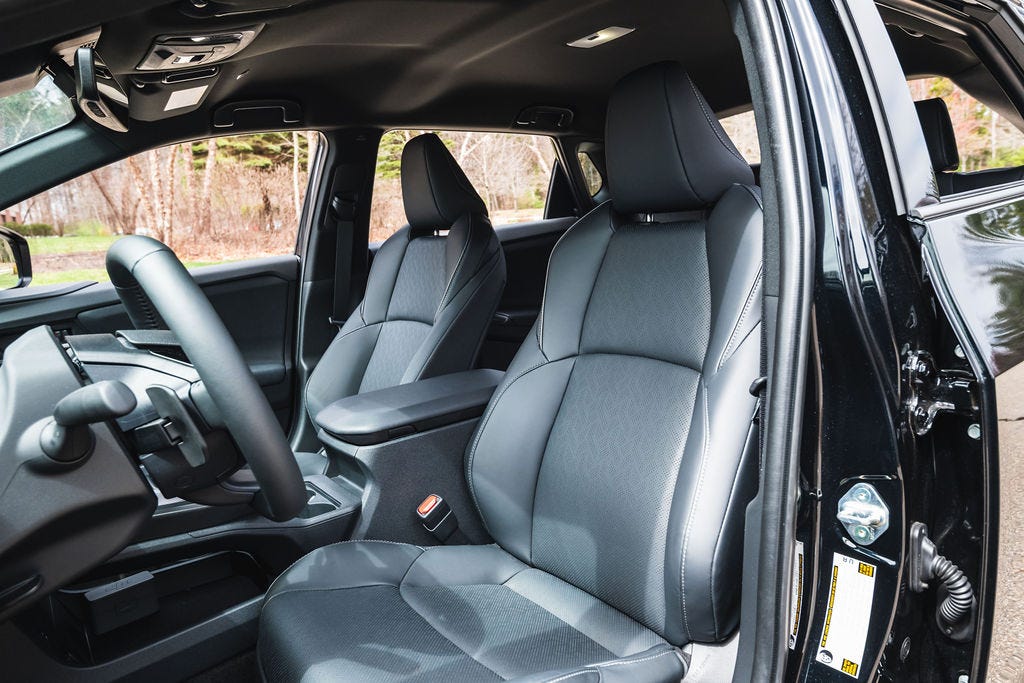
Though compact with just 35” of backseat legroom, the Solterra is perfectly fine for toting family members around town. In our case, 2 kids in the back and 1 up front made for a comfortable fit. The hatchback shape helps with the spacious cargo hold, one that opens up further with the fold-flat second row. There is no front trunk on the Solterra however, as the space is filled with EV running gear.
Subaru now makes a huge 14” infotainment touchscreen standard across the 2026 Solterra range. It’s easily switched off when you need a screen time break, and physical controls for the automatic climate control and volume are integrated along the bottom.
The squircle steering wheel felt awkward when conducting tight low-speed turns, but it looks nifty and helps open up a bit of room in a driver’s compartment that’s on the small side. That said, the Solterra is a treat to drive. It pops off the line, the steering is responsive, and the brakes are easy to modulate.
Relaxed Electronic Nannies
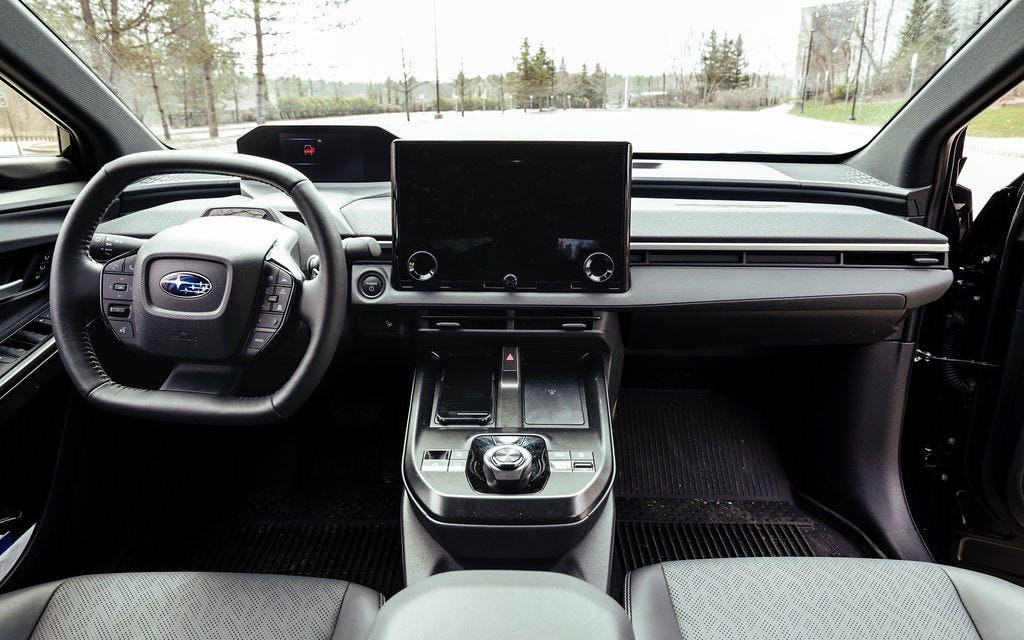
As with most new cars, Subaru’s compact EV is stuffed with the latest ADAS. In the Outback, some of these systems are overly sensitive, especially the driver attention monitor. But in the Solterra, I didn’t get any nagging electronic nanny vibes, which I’d guess is due to the use of Toyota’s advanced driver aids instead of Subaru’s. Whoever is responsible, thank you for making it so easy to toggle each system on and off using the infotainment screen.
For 2026, Subaru has dropped the previous CCS charging port in favor of NACS. This means Tesla Supercharger capability, which arguably adds to the appeal for tentative buyers as Tesla has done an admirable job of bringing charging stations online.
And, when using one of these Level 3 chargers to fill the Solterra’s battery pack from 10 to 80%, the max charging rate has increased to 150 kW, while the length of time required has dropped to 30 minutes, per Subaru. These are positive developments, but sitting around for 30 minutes to charge your car is pretty tedious. Certainly, this amount of time is competitive with the EV segment, but I would much prefer setting up a Level 2 station at home and charging the Solterra overnight if possible.
Subaru’s Growing EV Lineup
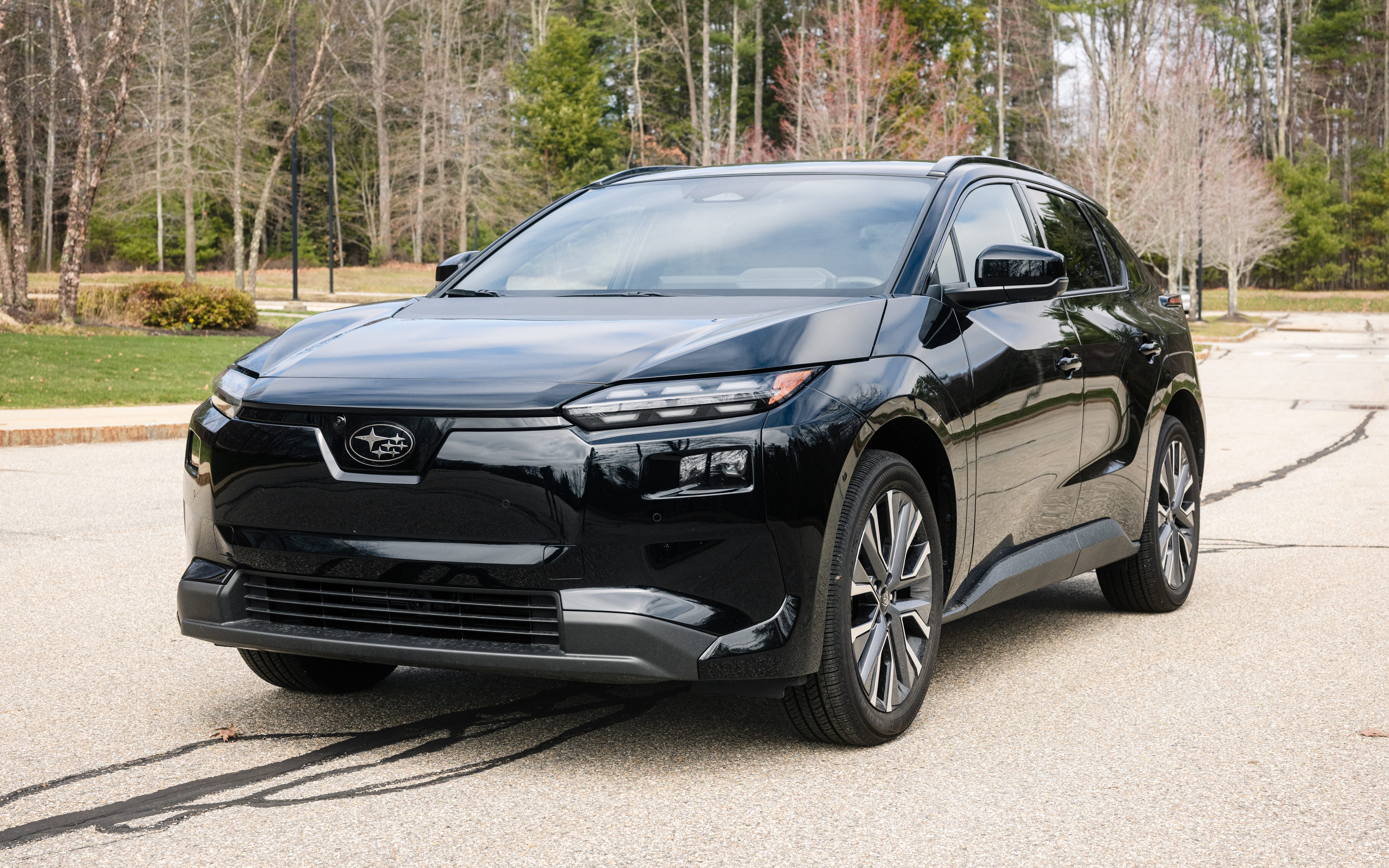
ICYMI, Subaru is assembling quite the EV portfolio. Below this Solterra is the Uncharted in the subcompact category that arrived for 2026. Above it is the also-new Trailseeker mid-size EV SUV, and slated for release as a 2027 model is the 3-row Getaway. Based on the all-around impressiveness of the Solterra, I’m looking forward to watching how Subaru’s increasing array of EVs performs in the marketplace.
About the author: Niel Stender is an automotive journalist. More of his work can be found at muckrack.com/niel-stender