
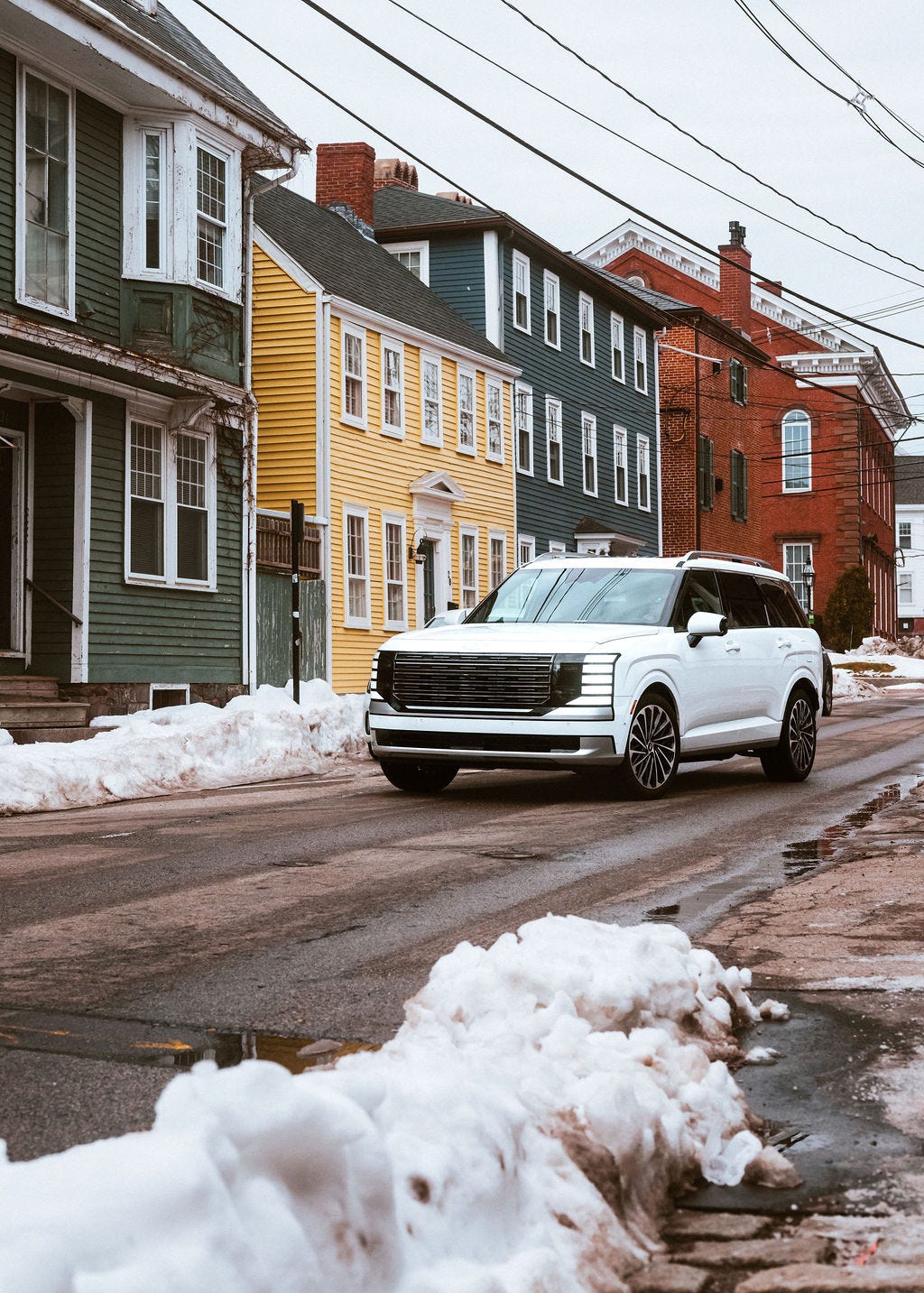
Big, three-row SUVs are a dime-a-dozen these days, with automakers clamoring to capitalize on this seemingly insatiable segment. Some look good and some look mediocre. But Hyundai has one that’s rocking a monochromatic finish, sweet 21” rims, miles of gadgetry, and a subtly luxurious vibe that belies its mainstream positioning. That being the all-new Palisade dolled up in Calligraphy trim. It’s a looker, which the tremendous-as-always shots taken by my brother, Tyler Stender, make obvious. After a full week of testing, here’s what the 2026 Hyundai Palisade Calligraphy gets right — and where it falls short.
How The Palisade Calligraphy Stacks Up


This is the Korean automaker’s biggest, most expensive gas-powered vehicle, and based on my time running around with it, I’d say they’ve got a winner. Sitting atop the Palisade trim ladder, Calligraphy’s start at a shade over $56,000. But specced with Creamy White Pearl paint and AWD, like the version I had, you’re looking at just under $59,000. This is a lot of money, yes, but not in the context of the Palisade’s competition. A top-line Mazda CX-90 comes in just over the 59 large mark.
So what’d you get for such an outlay? Many things. Creature comforts run the gamut from Nappa leather hides to massaging front seats, climate-controlled middle seats, and heated wayback seats - all of which are power adjustable. A panoramic moonroof comes standard, as does a heated steering wheel, a second-row HVAC control panel, a Relaxation mode that transforms your throne into a La-Z-Boy, and really nice ambient light.
I’m not one to gush about colored cabin lighting, but dang, when the sun goes down, the recessed illumination inside the Calligraphy cabin is *chef’s kiss. There’s legroom aplenty, even in the third row, thanks to a power-sliding second-row, and serious cargo flexibility. Also, you can stuff 5 carry-on bags behind those rearmost seats when raised.
A Bonanza Of Automotive Technology
So yes, comfort and cargo are covered in this top-spec Hyundai Palisade. However, it is in the technology department where this three-row SUV really shines. There’s not enough room on my digital paper to get deep on every single system Hyundai brings to bear with the Calligraphy. So, some highlights:
Digital Rearview Mirror
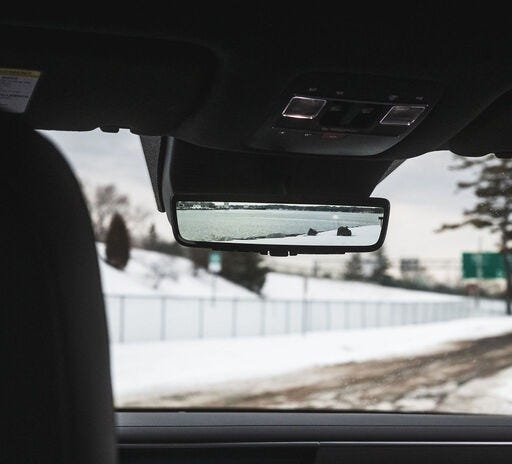
Flip the little nighttime anti-glare toggle under what appears to be a regular old rearview mirror, and the glass surface will render a live video stream of what’s happening behind your Palisade. The view is high-res, though a bit strange at first as your normally static mirror is now a wide-angle lens on everything moving around out back. Get used to it though, and you might appreciate the ability to actually see out there when your seats are filled with people and stuff.
Head-Up Display
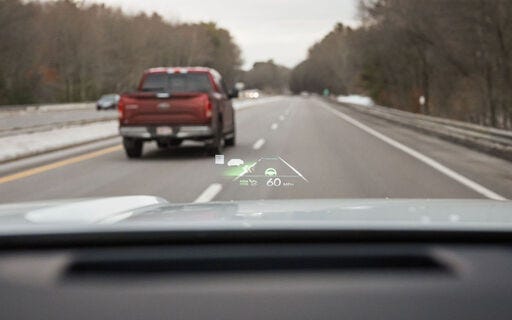
The head-up display, HUD for short, is nothing new in autodom. But Hyundai’s HUD takes this windshield projection tech to a new level. Beyond current speed, you can set it - or not - to show turn-by-turn navigation instructions, ADAS alerts, and info on who’s calling. To be clear, the Palisade Calligraphy is an absolute riot of technology with screens and information all over the place.
So while one more digital display may seem like overkill, I came to like having that info in my periphery, as it limits the need to glance down at the dash. The full-color HUD was easy to read in all conditions, except when wearing polarized sunglasses. In that scenario, the digits are legible, just a bit on the dim side.
Highway Driving Assist 2
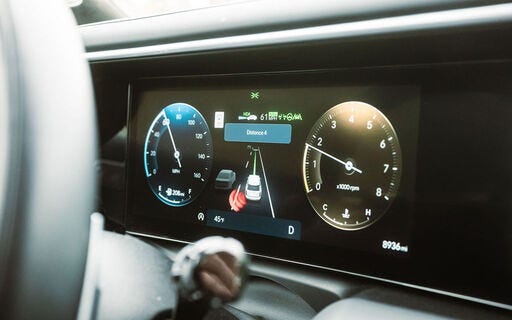
Okay, so I like analog cars sans giant touchscreens and driver aids squawking at me unexpectedly. That fussy mentality extends to all the high-tech systems trying to help you drive. Like Hyundai’s Highway Driving Assist (HDA) 2. In standard form, HDA blends adaptive cruise control with lane-following and centering. But HDA 2, only included on the Calligraphy, brings an automatic lane-change assist feature. If the idea of a car effectively driving for me was met with a furrowed brow, the concept of doing so AND changing lanes on its own was met with colorful language.
And yet, HDA 2 works incredibly well. Uncannily well even. Simply flick the turn signal stalk and let Hyundai’s computers take over. The system determines if a lane change is safe and then goes for it. Shifting lanes at highway speeds with my hands loosely hovering on the steering wheel - while it moves of its own accord - had those hands sweating. But I have to say, it was smooth, and the maneuver was executed flawlessly.
There’s so much more to the 2026 Palisade Calligraphy’s tech-forward intent, but my fingers can’t handle all the keyboard strokes required to get into the nuts and bolts of each. So instead, a quick hit of the best stuff.
Blind-Spot View Monitor
Displays a live feed of your blind spot in the gauge cluster when you trip the turn signal.
Dashcams
Front and rear integrated units with crisp resolution and parking surveillance.
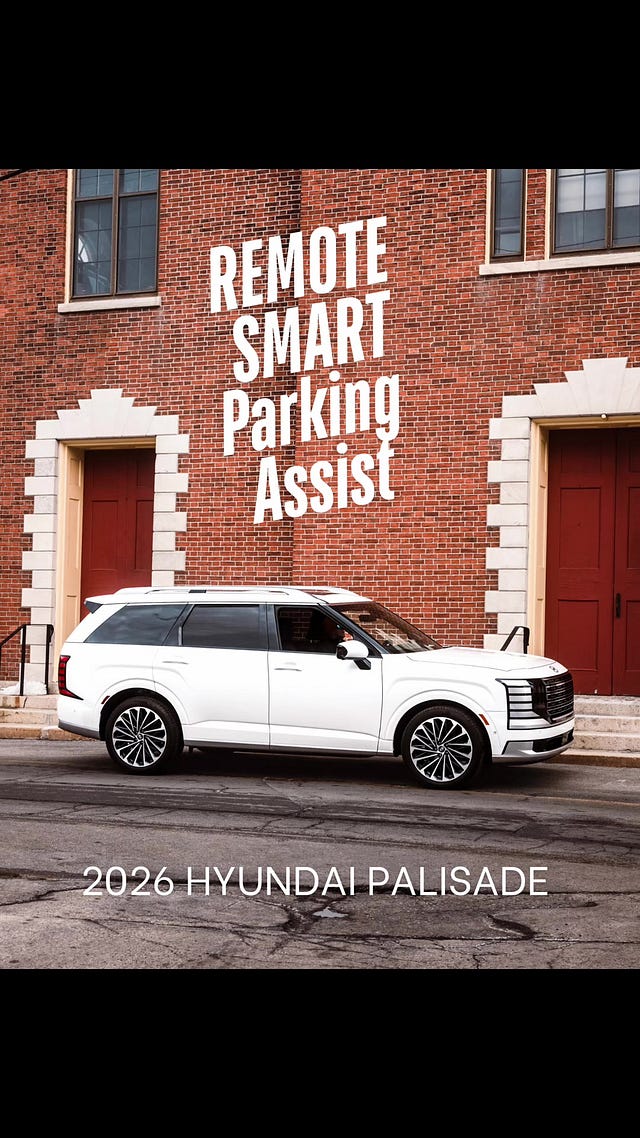
Remote Smart Parking Assist
This key fob-operated trick won’t parallel or perpendicular park for you, but it can roll your Palisade - forward or back - out of tight parking lot jams.
 Tiktok failed to load.
Enable 3rd party cookies or use another browser
UV Sterilization
The center console bin, with its clamshell-style lid, doubles as a UV sterilization chamber. Look closely and you’ll see little UV emitters in there. Set your no-doubt filthy device within, close it, press the UV button, and 10 minutes later you’ve got a very germophobe-friendly smartphone.
Driving The Palisade Calligraphy


So, what’s the Palisade Calligraphy like behind the wheel? Smooth, hushed around town, and comfy. The steering is a little sleepy, but if you want to carve corners on the way to the grocery store, get an Elantra N. Road impacts are what you’d expect of a shiny, new family SUV - soft, rounded, and not likely to bother occupants. When pushed hard, the Palisade feels poised, and the naturally aspirated 287-horse V6 under the hood pulls strongly. It also drinks strongly; I registered just 14 mpg around town.
That’s not great, but much like Hyundai makes cars for corner-carving, it offers the Palisade in hybrid flavor for those looking to stretch a gallon of gas. The cabin felt quiet at low speed, but was boomier than expected on the highway. That sense wasn’t too far off reality. Using the NIOSH Sound Level Meter app, I measured 66 dBA of cabin noise at 65 mph, the same as a Ram 1500 Warlock with big off-road tires. I realize an iPhone app isn’t exactly the sensor of choice for lab-coated scientists, but using that same sensor across multiple vehicles does give a relative reading, one that was louder than I would’ve guessed.
The Palisade Isn’t Perfect


I was impressed with the Palisade, but no car is perfect. Admittedly, my asterisks are just minor annoyances. Like trying to access the storage area positioned on the first-row floor in front of the center console. A console that extends so far as to make reaching down tricky. Trying to come at it from the sides doesn’t help since you can’t see what you’re fumbling around for. A guaranteed collector of forgotten doo-dads, it would appear.
Also, the power-operated second-row seats take quite a while to get out of the way. I found myself wishing for a simple manual lever to make it move. And can we ease up on the aggressiveness of the various alert systems? When my daughter didn’t get her door closed fully, the Palisade waited for me to back out of the driveway before lighting up the IP with red flashing lights, accompanied by stick-your-finger-in-an-outlet levels of shock from the piercing auditory alert. Because the door wasn’t fully closed. Sometimes, you can go too far with technology.
Is This Range-Topping 2026 Palisade Worth A Look?
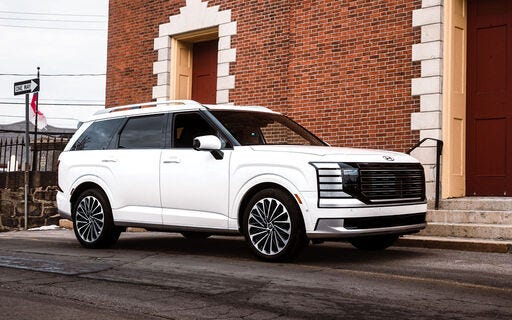
My time with the 2026 Hyundai Palisade Calligraphy has come to a close, but I enjoyed it while it lasted. Exuding Range Rover vibes from the outside and coddling with creature comforts galore on the inside, it’s one nice SUV. The technology left me wildly impressed - except for that door ajar tantrum - and really, in the grand scheme of what this $59,000 Hyundai offers, that’s not a big deal. For the family ISO a vehicle that steps up the luxury digs a notch, the Palisade Calligraphy is worth a look.
Be sure to check out our quick debrief on the Palisade Calligraphy with The Knocking Rod podcast!
About the author: Niel Stender is an automotive journalist. More of his work can be found at muckrack.com/niel-stender.