
It’s been cold in New Hampshire this winter, with many a single-digit thermometer morning. Go about 75 miles north of Montreal, however, and words like bitter, frigid, and bone-chilling come to mind. It is here that the Circuit Mécaglisse is located, a winter wonderland of ice-covered tracks and deeply snowed forest trails. Just the place to put winter tires to the test, which I recently did with Michelin and its new X-Ice Snow+, a tire that features not just the 3PMSF designation, but the perhaps lesser-known Ice Braking icon.
Winter Tires > All-Seasons + AWD In The Snow


Once you experience the difference between all-season tires and dedicated winter rubber - with the 3-Peak Mountain Snowflake (3PMSF) sidewall icon - on your car during a snow storm, it’s hard to argue with the benefits. That little mountain logo with a snowflake indicates the tire has passed the ASTM F1905 test, a standardized protocol that means it has better acceleration on the white stuff than a typical all-season tire.
In a conversation I had on-site with David Griese, Michelin Product Category Manager, Winter, we discussed how the prevalence of AWD crossovers has perhaps boosted consumer confidence while driving in the snow. But the reality is, no matter how much torque your car’s drivetrain can route to a wheel and no matter how sophisticated that delivery system is, there’s nothing to be done if the tire can’t get a grip.
Listen To The Interview With David On Spotify

Over the years, I’ve watched endless all- and four-wheel drive vehicles flounder in winter weather, while I powered through in a front- or rear-wheel drive car fitted with snows. Our Ford Transit Connect, which I recently gushed about as the perfect family ski vehicle, capably ran the Monarch Pass in Colorado…in the dead of winter…on snowy roads…with winter tires and FWD. Point is, I’m in the Winter Tire Fan Club, so I jumped at the chance to put Michelin’s latest compound through its paces.
The X-Ice Snow+ Is Arriving Shortly


Arriving in early summer 2026, the X-Ice Snow (XIS)+ will replace the X-Ice Snow that debuted 6 years ago. Per Michelin, this version has 26% longer tread life and 34% better fuel efficiency than 3 leading competitors from Bridgestone, Continental, and Nokian. I can’t speak directly to those metrics, but I can confirm the XIS+ left a positive seat-of-the-pants impression at the Mecaglisse.
Eagle-eyed winter tire nerds may notice that the XIS+ has the same tread pattern as the previous XIS. This is deliberate, as Michelin found the mechanical grip - tread blocks, sipes, and grooves - needed no improvements for the XIS+. Changes were made to the chemical grip side of the equation as part of the new Flex Ice 3.0 tread compound. Michelin understandably won’t share the specifics of what it did to alter the chemical recipe, as this is the proprietary secret sauce. They did, however, give me some insight as to what make the XIS+ different.
The elastomer forms the foundation of the tire’s rubber compound and is typically made up of Natural Rubber, Butadiene Rubber, and Styrene-Butadeine Rubber, or a combination thereof. In the X-Ice Snow+, Michelin has created a new, next-generation elastomer. The same is true of the tire’s plasticizers, which improve processability and flexibility at cold temperatures. However, the fillers that help adjust performance metrics like traction, wear, and rolling resistance - and usually consist of carbon black and silica - have simply been fine-tuned.
Driving Michelin’s New Winter Tire On The Ice And In The Snow

Based on back-to-back comparison tests of the Michelin XIS+ versus a variety of other major brands, these updates clearly make an impact among the competitive set. In one test, I drove Chevy Equinox EVs fitted with the Michelin tire, followed by the same vehicle with Nokian Hakkapeliitta R5 EV rubber, and then a third identical Equinox running Continental VikingContact 8 winter tires. The run was a tight, twisty setup with a bit of elevation and plenty of cones to try and avoid. As the name implied, this ice handling course was a literal sheet of ice with just a dusting of snow on top.
However, once I got going, that snow was quickly banished, allowing the ice beneath to become increasingly polished. For me, it was tough to discern a major difference between the 3 tires in this scenario. This could be partly chalked up to how the course became progressively more slick as the ice received a deeper polish over consecutive runs. The Continentals did seem to lose lateral grip more quickly, but only slightly so. Under hard panic stops, all three setups felt admirably strong given the conditions.


Over in the deep snow arena, results were different. First, I ran a Toyota Corolla on the Michelin X-Ice Snow+ setup, but after being shaved to 4/32” tread depth as a way to simulate worn tires. Against identical Corollas with equally trimmed Bridgestone Blizzak WS90s, I was left impressed with how well the Michelins got through the deep stuff with better traction than the Blizzaks. All the more impressive considering how much tread had been removed, but doubly so when brought to a dead stop on an icy incline. Starting back up, the XIS+ Corolla easily crept up and over the hill, while the car with the Blizzaks put on a fishtailing show before getting moving.
Finally, I drove through even deeper snow in a Toyota RAV4 with brand-new Michelins, followed by a matching setup with the Continental VikingContact8. In this portion, the snow was deep and soft enough that the only way through was steady accelerator pressure and constant steering wheel sawing to sling the SUV back, forth, and forward. With the Continentals, the RAV4 was trying to tramline through the deep ruts, while the Michelins felt comfortable cutting their own path across those grooves.
Reducing Road Noise With Piano Acoustic Tuning
It’s not just upgraded chemical grip that Michelin points to as why the X-Ice Snow+ marks such a major improvement over its predecessor. Winter tires tend to be noisier on the road than their all-season sisters. To counter this, the XIS+ features “Piano Acoustic Tuning” technology, which is effectively computerized frequency tuning. When features of a tire - like tread blocks and sipes - are equally spaced around the circumference, you can get repetitive high and low frequency vibrations that have a tendency to create unwanted road noise.
With Piano Acoustic Tuning, Michelin can create a non-repetitive tread block-width and sipe-spacing design to break up this noise and deliver a quieter ride. Given my focus (read: excitement) at running the XIS+ through the various testing protocols, I can’t say I noticed a difference in noise against the competition, but the science behind it certainly makes sense.
Key Visual Aspects Of The Michelin X-Ice Snow+


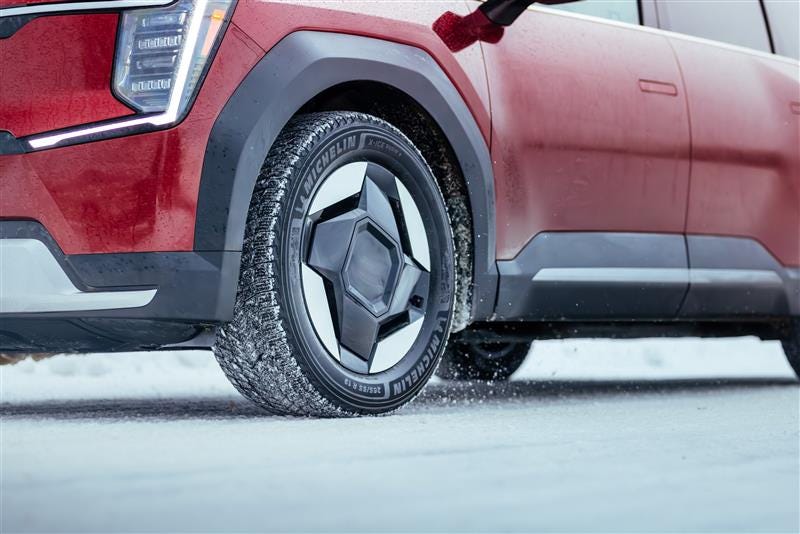
Two notable aspects of the Michelin X-Ice Snow+ are what you’ll see, and won’t see, on the sidewall. What’s missing are any letters suggesting this tire is made for electric vehicles (EV). A tire like the Nokian Hakkapeliitta R5 EV, that I drove on the Chevy Equinox EV is different from the regular Nokian Hakkapeliitta R5 tire as it is aimed at the electric market. The XIS+, according to Michelin, was designed to work on all vehicle types - ICE, hybrid, and EV - as a way to reduce consumer confusion.
There is no international standard for the EV lettering on a tires sidewall, so it is ultimately a marketing move. Given the relative complexity of the tire market for the average consumer - all-season vs. all-weather vs. winter - this seems like a good way to encourage winter tire adoption across the customer spectrum.

Though the previous generation XIS tire was rated for Ice Braking, the icon that designates this was not included on the sidewall. Like the 3PMSF logo, the Ice Braking logo - a single-peaked mountain - certifies a tire has met standardized testing performance on a polished ice surface, per the ISO 19447 standard. Not every winter tire offers this level of winter performance and based on how the test is structured, it’s more representative of how a car would perform in real-world conditions.
For the 3PMSF test, only 1 rear wheel of the test vehicle needs to be fitted with the tire under evaluation. But for Ice Braking, all 4 wheels must be fitted as such. As David Griese noted in our discussion, the Ice Braking designator is challenging to pass and puts a tire in the elite level of winter performance. In conversations with Canadian tire dealers, some of whom are located in provinces that mandate tires with the 3PMSF symbol between December and March, Michelin has learned that this symbol on its own is not all that helpful aside from meeting the letter of the law.
The Winter vs. All-Weather Tire Question
Credit: Michelin
That jives with all-weather tires, which are are a 4-season winter tire compromise. This category of rubber, which slots between all-season and dedicated winter, comes with the 3-Peak icon. That means it’s technically passed the snow traction test, but these particular tires are designed for use all year at the same time. Certainly there are regions where such a setup would work.
However, for anyone living in areas with heavy winter weather, it’s probably not the best choice. For those folks, you would ideally strap your ride with true snow tires. And if that’s the case, go beyond just the 3PMSF logo and find something with the Ice Braking indicator as well. The Michelin X-Ice Snow+ is one such tire, and I can tell you that I’ll be giving them a strong look when it comes time to replace my current winter tires.
About the author: Niel Stender is an automotive journalist. More of his work can be found at muckrack.com/niel-stender.