Over the years, there have been many sweet rides in my driveway. The old 5-speed Jeep Cherokee with its torquey straight-6, the Mitsubishi Starion with its wild punch of turbo boost, and that nimble first-gen Mazda3 hatch. But, I would have to point to the 2006 Volvo V70R with the 6-speed Spaceball stick as the most excellent of all. When those wagons first came out, I distinctly remember seeing one, painted red, sitting outside the dealership in Summit, New Jersey.
Love Letter To My V70R
Too expensive for my 24-year-old self, I waited years to get a hold of one on the used market. Which I finally did and had a blast in the process. Volvo has always known how to pen a proper long roof and in my extra mediocre opinion, that generation V70 in R guise was one of the best. Not without its faults - like wildly expensive replacement dampers and a ludicrous turning radius as a fellow V70R owner recently reminded me - the car was nonetheless excellent.


So, when the opportunity presented itself to visit Volvo’s HQ in Gothenburg, Sweden for a deep dive on its history of safety and a drive of Volvos from the vault, I had to pinch myself. As it turns out, this was in fact happening and what ensued not only checked many of my Volvo enthusiast boxes but also knocked my socks off in the process on the safety front.
Volvo Safety Beyond The Stars
The title of this event was “Volvo Safety Beyond The Stars”, a description that sounded to me like a breathless exclamation of how amazing Volvo’s safety is. Otherworldly, defying description, and the best in the known universe. Incorrect. It simply meant Volvo’s safety goes beyond the star-based ratings used by the NHTSA in North America and NCAP in Europe. Turns out the Swedes are a very literal people. I like.
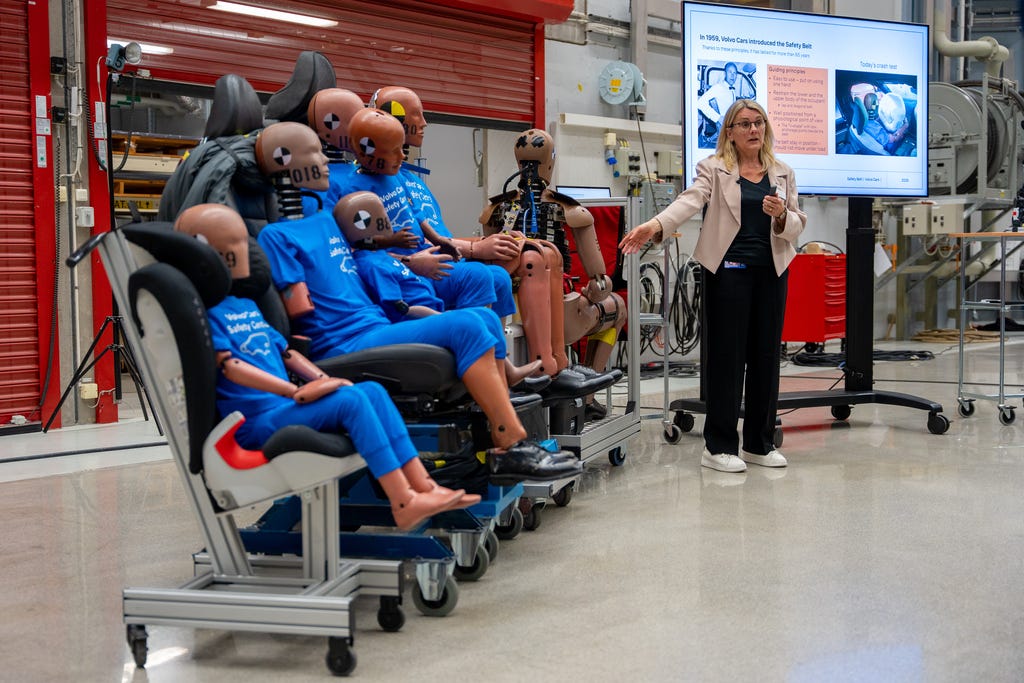
These folks, at least those I met during the event, were also very serious about their work in safety engineering. Often having 20- and 30-year tenures at Volvo, you could immediately see that this was more than a job. Senior Safety Advisor Thomas Broberg has been at Volvo for 30 years. Dr. Lotta Jakobsson, Senior Technical Specialist, Injury Prevention, has been at it for 35 years. These are just 2 of a long list of Volvo employees who clearly love what they do.
A Reputation For Safe Cars
Which jives with Volvo’s long-running reputation for building safe cars. Ask most anyone what they think about Volvo and safety will often be the first thing that comes to mind. After listening to, talking with, and getting an inside look at what the Swedish automaker’s employees are up to behind the scenes, it’s easy to see how Volvo has cultivated this reputation. Some interesting facts around this topic:
The Volvo Cars Safety Center has performed more than 7,000 crash tests over the past 25 years
An 850-ton barrier (read: massive block of steel) is used in these tests and once moved 0.1 inches upon impact from a 12-ton semi-truck at 50 mph.

1 of the 2 crash tracks can rotate between 0 and 90 degrees - as in the entire section of the building can pivot - to allow for different crash angles
Maximum speed in the crash lab is 75 mph
Volvo has a life-size moose crash-test dummy because, as Anders Bell, Chief Engineering and Technology Officer, said, “This is Sweden.”
Behind The Scenes In Volvo’s Crash Lab
Witnessing a live crash test of the Volvo EX90 was a highlight of the safety center visit. Front and center, under lights, and at the end of a long, dark tunnel was the first EX90. Positioned much like that goat used to lure out the T-rex in Jurassic Park, anticipation was high and voices silenced as a verbal countdown ensued. Suddenly, a second EX90 shot into view and…stopped within kissing distance of the first EX90. Confused chuckling from observers followed with a sense of confusion. “Um, wasn’t it supposed to crash into the other one??”


Which is when a third EX90 rocketed out of that long, dark tunnel and slammed full-bore into the driver’s side door of the original SUV. I’ve watched plenty of crash-test videos, but seeing it in person was much gnarlier. It’s worth noting that the energy from that crash was 30% higher than the most severe side-impact test required in standardized testing. “Safety beyond the stars”, get it?
A Culture Of Automotive Safety In Sweden
All of this is part of Volvo’s deep-seated passion for building safe cars. It goes all the way to back when the company was founded by Gustaf Larson and Assar Gabrielsson, who said, “Cars are driven by people. The guiding principle behind everything we make therefore is – and must remain – safety.” Since then, Volvo has been at the forefront of automotive safety and continues that effort today. As evidence of this, we met the Traffic Accident Research Team.
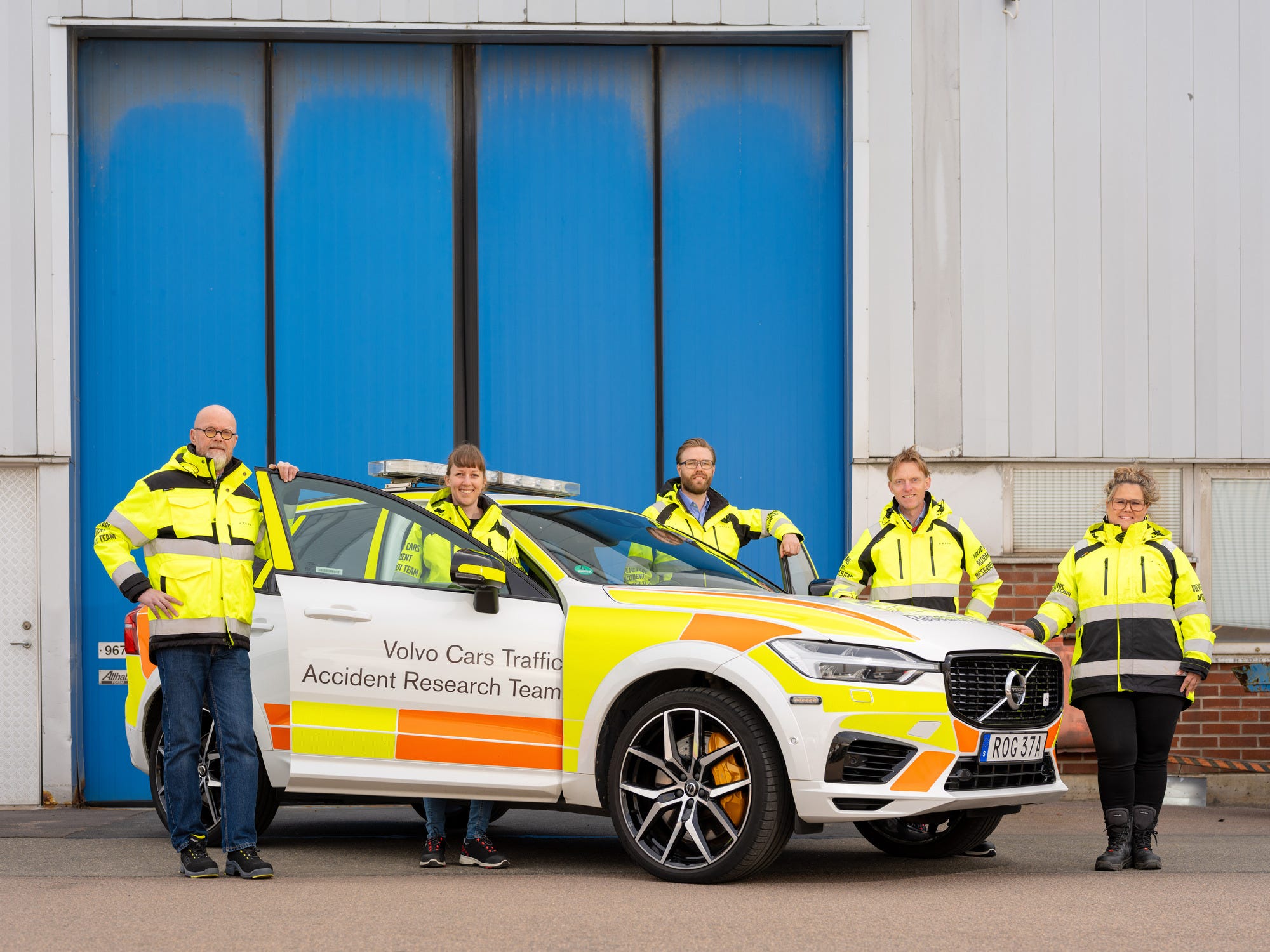
These are the folks who investigate crashes involving Volvos in person, collecting data and, in some cases, the vehicles for further study. I saw the results of this work up close with two Volvos that had been involved in horrific accidents. Photos and videos were not allowed due to privacy, but trust me when I tell you, it was hard to imagine how the drivers of these Volvos survived and made full recoveries. Fortunately, employees like Dr. Ulrich Sander, Senior Technical Leader, Safety Data and Analytics, were on hand to explain the how.
“Cars are driven by people. The guiding principle behind everything we make therefore is – and must remain – safety.” - Volvo company founders
Of course, Volvos are built with the latest safety innovations from the structure and airbags to collision mitigation technologies. But, arguably, the most important aspect of how Volvo engineers its cars to keep drivers safe in head-on collisions and high-speed impacts comes from the decades-long work being done with data. For more than 50 years, the company has been collecting information on crashes involving its cars and currently, the number of accidents in the database stands at more than 70,000.
Volvo Reinvents The Seatbelt
All of this information guides research being done to improve future Volvos. This kind of continuity requires incredible dedication and according to Volvo, it is the only automaker in the industry to do so. It’s a remarkable effort and one that will soon translate into making an existing safety system better at its “job” over time. The seatbelt. But not just any seatbelt, the all-new multi-adaptive seatbelt Volvo is putting into production with the 2026 EX60 electric crossover.


If you didn’t know (I did not), Nils Bohlin invented the modern 3-point safety belt at Volvo back in 1959. Today, it’s easy to take those straps of webbing and buckle mechanism for granted. But keep in mind, although initially met with criticism, the 3-pointed belt has since been adopted by every carmaker around the world and has been credited with saving the lives of more than 1 million people. So it’s kind of a big deal. As is the bold move to reinvent it, which is what Volvo is doing with the multi-adaptive seatbelt.
The All-New Multi-Adaptive Seatbelt
At a glance, this new belt appears simple. The webbing used matches that of current seatbelts and the retractor mechanism is only 7 mm larger than before. However, within that mechanism is a state-of-the-art system that can customize the load-limiting profile of the belt in the blink of an eye. With the current 3-pointed seatbelt, there are 3 of these so-called load-limiting profiles, which manage the force applied to occupants during an accident.
“The world-first multi-adaptive safety belt is another milestone for automotive safety and a great example of how we leverage real-time data with the ambition to help save millions of more lives. This marks a major upgrade to the modern three-point safety belt, a Volvo invention introduced in 1959, estimated to have saved over a million lives.” - Åsa Haglund, head of Volvo Cars Safety Centre
With the multi-adaptive belt, the number of profiles increases to 11. For example, the load-limiting profile of a pregnant woman in a low-speed crash should be different from that of a high-speed accident involving a 250-pound man. By capturing real-time data from interior and exterior sensors, this system can take vehicle speed, accident direction, and passenger posture into account before choosing an appropriate profile. All of which happens nearly instantly and is utterly invisible to occupants.
Perhaps the best part of this reinvented seatbelt is that Volvo can make it safer over time. Using over-the-air updates, the company can improve the multi-adaptive seatbelt’s efficacy based on findings from all the data collection and research being done in the safety lab. Quite the self-propagating loop of automotive safety. It will be interesting to see if, like the original 3-pointed safety belt, the rest of the auto industry ultimately adopts this new design. Certainly there will need to be some discussion around how much safer this new belt is versus the original, but Volvo did not have that information as of yet.
Driving Volvos From The Vault
Now, I’ll be honest, if you asked me before attending whether I’d be more excited to learn about Volvo’s safety or drive cars from its heritage vault, the old cars would have won hands down. And it was in fact an excellent experience as I’ll get to in a moment. But, I have 3 kids and much as I love the simplicity of classic cars like a 240 wagon, there’s no denying the modern safety-related work Volvo is doing left me very impressed.
Prior to this affair, I’d been toying with the idea of a V90 or V60 (preferably by Polestar) as perhaps the next ride. After getting an up-close look at how serious the Swedish automaker is about safety and how its cars literally go beyond the stars when it comes to safety ratings, I will absolutely be looking at Volvo when it’s time for the next car. But about that heritage drive event…


Picture this: A 65-degree day, partly cloudy with plenty of sun, and a finely finished ribbon of asphalt winding through the woodsy backyard of Volvo’s campus in Gothenburg, Sweden. Parked out front, a row of 14 kick-ass vintage Volvos from the company vault, ready to be driven. Of course, these weren’t just any old Volvos. Each was selected for having debuted an important safety innovation in the past. From the 1960 PV 544 to the 1973 1800 ES and the 1995 850 wagon, there were many impressive vehicles.
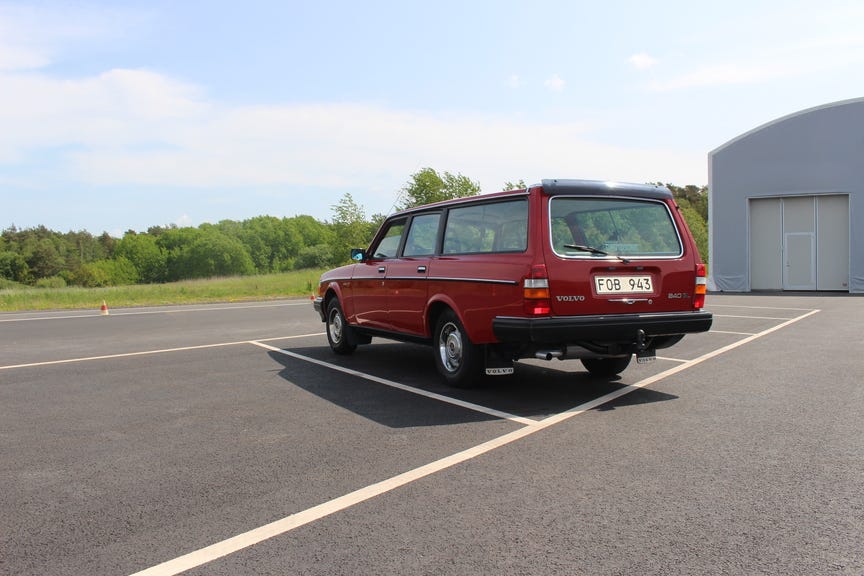
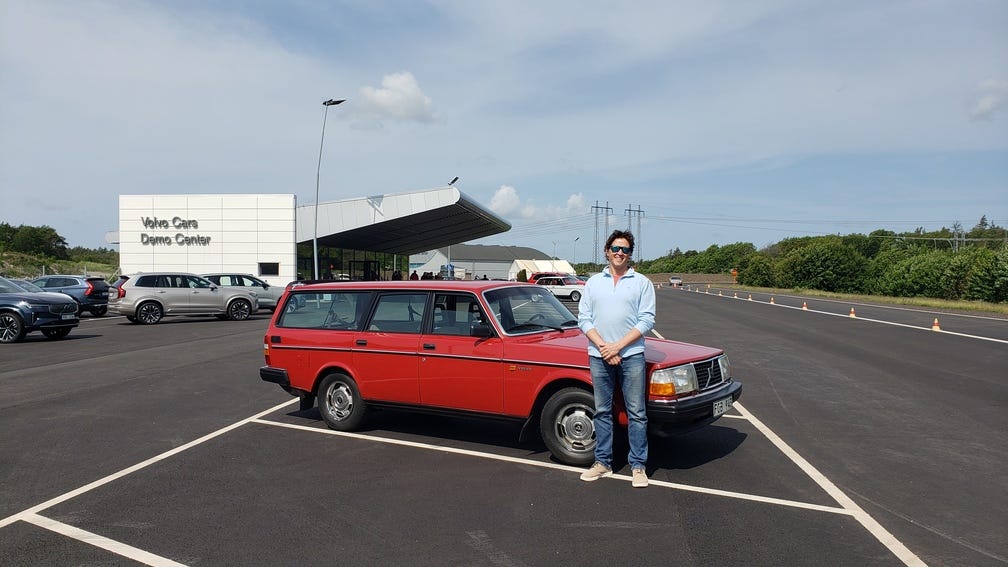
Naturally, I immediately blanked on what made these Volvos special from a safety perspective as we were given effectively free rein to take them for a spin. One that jumped out at me was a red 1984 240 wagon with a stick. Wow. That classic boxy shape, the big airy cabin, and three pedals? Yes and please. Immediately calling to mind the 240 wagon my college roommate arrived at school in, replete with big cabinet speakers mounted in the trunk, driving this Swedish long roof was a highlight. As was the 850, and the 145 wagon, and the…well, really, all of these heritage Volvos were excellent in their own right.
ISO: 1980s-Ish Volvo 240 Wagon With 3 Pedals
Pulling together a who’s who of vintage Volvos to tie together the company’s heritage of safety was cool. And clever. I arrived in Gothenburg assuming it couldn’t get much better than my V70R. But I left with a new appreciation around where Volvo’s reputation for building safe cars comes from. Not to mention an unhealthy amount of time browsing Bring A Trailer for 240 wagons. But that’ll be a story for another day.