
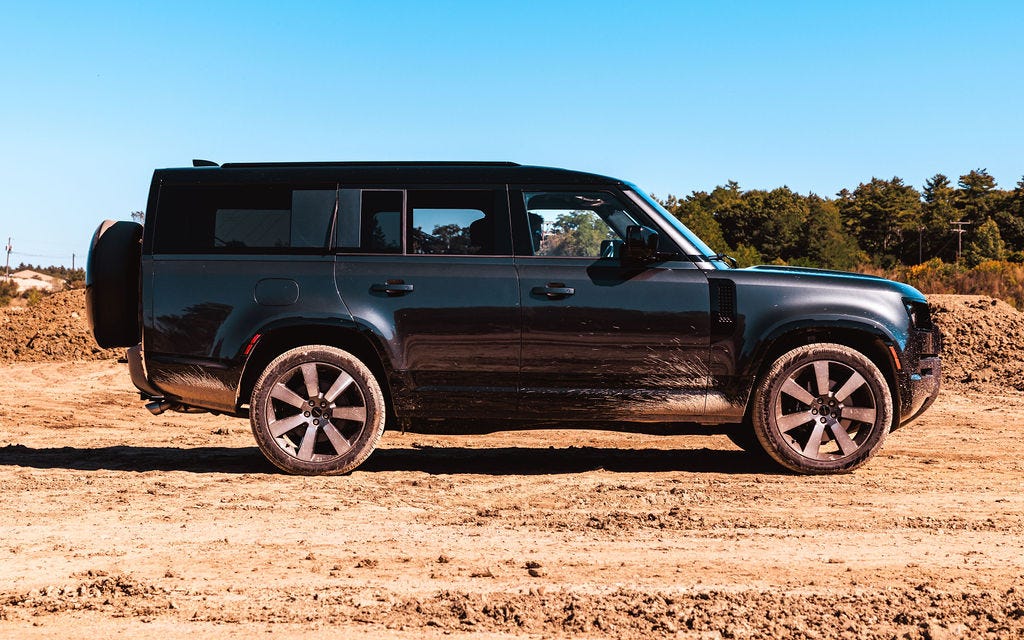
I understand the need for more fuel-efficient cars and fully support it. When asked, a hybrid of some ilk is my go-to recommendation, should 100% battery power not be a palatable option. And I love a full-throated, gas-guzzling, internally combusted mill. Like, say, the 518-horsepower supercharged 5.0L V8 in the Land Rover Defender 130. The ruggedly handsome exterior of this square-jawed SUV offers no indication of what’s lurking under the hood. The refined ruffian. A velvet-gloved iron fist. Brute in a suit. Call it what you will, this V8 in that Defender is automotive magic. And it’s all going away next year.
All photos by Tyler Stender
Fit For The Cotswold Country Home


The Defender lineup is deep for 2026 with the 2-door 90, and a pair of 4-door offerings in the 110 and 130. These latter variants share a wheelbase, but the 130 is 14” longer. All modern Defenders do a fine job emulating the Defenders of Camel Trophy lore. Really, I’d say improve upon. But the 130 spec is the grandest, an SUV that casually rolls through town on 22s, dressed in Carpathian Gray, and appearing to the casual onlooker as an ideal partner for a hunt at the Cotswold country home. Or a Whole Foods parking lot in New Jersey. Really, it can do both, and then some.
The Surprising Agility Of A Land Rover Defender 130


Though Defenders feature aluminum-intensive unibody construction, the V8-powered 130 weighs close to 6,000 pounds. Fortunately, the adaptive air suspension works seamlessly in the background to deliver surprisingly agile dynamics, all while soaking up broken pavement with ease. Dial up Dynamic drive mode for extra roar from the engine and sharper throttle responses, should you be feeling particularly frisky. Or double-tap the suspension button to fully inflate the corner airbags for nearly a foot of ground clearance and get loose in the wild. Four-wheel low range and locking center and rear differentials further the off-road credentials here.
A note about the wheel and tire package. Done up in dark-finished twenty-twos, the Defender drips with Q-ship vibes. On that front, a pair of small V8 badges and dual twin-tip exhaust outlets are the only indicator this is the top dog. Love it. But, those big rims are wrapped in all-season rubber. Not exactly prime for the visions of globe-trotting adventures portrayed in Land Rover’s TV ads. Fortunately, if you’re planning to lean into the 4x4 side of the house, a set of all-terrain tires - on still-large 20” wheels - is a $500 factory option.
Vestigial Spare Tire Carrier
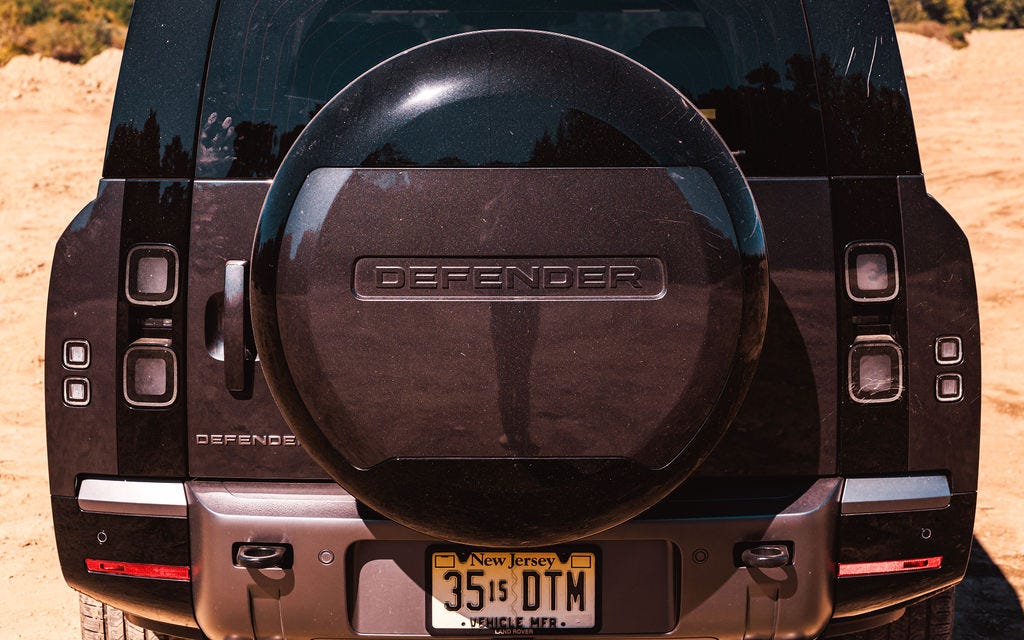
Something all Defenders must have to be part of the club is an external spare tire carrier hanging off the tailgate. It looks cool and serves as a form of instant identification. But it’s so big as to get in your way on the outside - when trying to navigate around the thing in a parking lot - and inside from a visibility perspective. Fortunately, you can toggle the rearview mirror to digital mode as needed.
End Of The Classic Defender V8 Era


Now, about that engine. It comes from Land Rover’s AJ-V8 family of lumps, a lineage that dates back nearly 30 years. Arguably, a Defender is not a Defender without a V8. But there’s no escaping increasingly stringent fuel efficient regulations, and so, 2026 will be the final year you can buy a Defender with this V8. Those in the know know that Octas still have a V8 fit for the Sara Price School of Driving, but that is the 4.4L twin-turbo version. A perfectly wonderful powertrain, no doubt, but these days that configuration almost seems pedestrian. Supercharged 5.0L V8 on the other hand? Downright exotic.
And it sounds so good. Not crazed or wake-the-neighbors loud. On startup, anyone standing nearby may be taken aback at the growl, however. Out on the road, when pressed, it comes alive with a gruff rumble, while the front end appears to lift off from its suspenders. The 8-speed automatic goes about the task of routing power to all four corners so smoothly you’ll forget it’s there. Car and Driver put the 0-60 time at 4.6 seconds for a Defender 110 with this engine. I have no fancy testing gear to back this up, but seat of the pants metrics point to something in the neighborhood of Hell Yeah.
The flipside to the V8 is the only real downside to this Defender. It’s a stinker in the fuel economy department. The EPA pegs it at 14 mpg around town, 19 on the highway, and 16 combined. I saw 14 mpg, in mixed driving, over a few hundred miles. And yes, the Defender 130 V8 requires premium. So, with a 23.8-gallon gas tank and a current AAA-provided national average price of $5.32 for a gallon of the good stuff, you’re looking at $126.62 to fill ‘er up. Oddly enough, the sticker on this Defender is right around 1,000 times the cost of a full tank. Okay, 1,015 times to be exact. So maybe buyers of this steed aren’t super concerned with such math, but it’s nobody’s definition of cheap.
Room, Comfort, And Subtle Luxury Galore


Inside, the biggest Defender is plenty spacious with 39” of second-row legroom, room for 7 (or 8 when fitted with a second-row bench), and up to 74 cubic feet of cargo room. Land Rover does make the cargo floor stowage tray standard at this point, as a way to create a flush load floor. This was something of a bugaboo for early Defender adopters (its modern iteration arrived in 2020). As for comfort, the first two rows of seats are heated and ventilated, though massaging front buckets are disappointingly missing. I know, I’m such a softie, but for $128,510, this seems like a given bit of content. Land Rover Windsor leather is in a league of its own; I highly recommend it.
Neat touches include an upholstered magnesium structural bar running across the dash. It doubles as an oh-shit bar with integrated handholds on either end for pulling yourself up and into the cabin. Note: Even with the air suspension in its lowest access height, shorter folks may find ingress a bit challenging. Another are the clever multi-function center stack dials. Many automakers, including Land Rover with its Range Rover Sport, have gone too far in deleting physical cabin controls in favor of haptics. Mercifully, the 2026 Defender does not subscribe to this approach.
Spinning the outer dial rings adjusts cabin temperature, unless you press the dial face, in which case you’re now controlling the front seat heat and ventilation. Two buttons sit between the dials. Press one to convert the left-hand dial into a drive mode selector, and the other to control HVAC fan speed. It takes a minute to figure out and then quickly becomes intuitive.
Glorious Excess Defines The Defender 130 V8
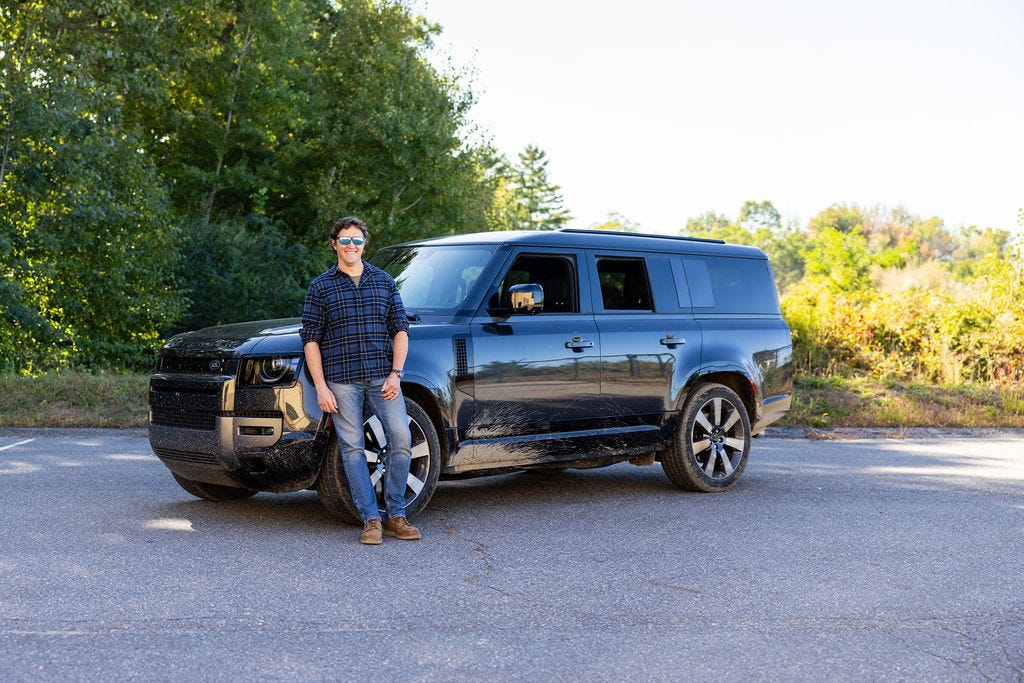
Ultimately, the 2026 Land Rover Defender 130 V8 is glorious excess. Need room for the whole family? Get a minivan. Want to look good at the country club in the process? See: Toyota Sienna Platinum. What about off-roading? Check the Woodland Edition box on that Sienna order form. Okay, that’s a stretch. It’s easy to debate all the reasons this Defender is over the top, but that doesn’t change the fact that it is an epic rig or that I want one.
About the author: Niel Stender is an automotive journalist. See more of his work on MuckRack.
There is something gloriously ridiculous about putting a 518-hp supercharged V8 into something this enormous, and I'm very glad Land Rover did it. I'm all for better fuel economy too, but I'm going to miss engines like this as they disappear. Also, "seat of the pants metrics point to something in the neighborhood of Hell Yeah" may be my favorite performance measurement I've encountered in a car review. 😂